API Versioning Strategies
1. Introduction
Any successful API will need to change over time. New features are added, old behavior is refined, and sometimes mistakes in the initial design are corrected. Without a clear versioning strategy, these changes can break existing clients and erode trust in the API. Versioning is the discipline of managing change so that clients know what to expect.
This guide examines practical strategies for versioning HTTP based APIs. It compares path based, header based, and media type based approaches and explains the trade offs between them. The goal is to help you pick a strategy that fits your environment and apply it consistently.
Versioning is only useful if it is predictable. The guide therefore emphasizes communication and deprecation policies as much as URL patterns. A clean technical design is not sufficient if clients cannot tell when a breaking change is coming or how long old behavior will be supported.
2. Who This Guide Is For
This guide is for backend developers and API designers responsible for public or internal APIs that serve multiple clients. It is especially relevant if you maintain mobile applications, third party integrations, or long lived automation scripts that cannot be updated instantly.
It is also helpful for engineering managers who need to balance the desire to improve APIs with the obligation to keep existing integrations working. Understanding the implications of different versioning choices makes roadmap discussions more concrete and less risky.
3. Prerequisites
Before applying these strategies, you should have a basic understanding of HTTP methods, status codes, and request and response bodies. You should also have a stable deployment process so that you can reliably roll out new versions and roll back if necessary.
You will benefit from having an inventory of your current clients and their needs. For example, if some clients are operated by external partners and others are internal tools, they might tolerate different levels of change. Understanding these constraints helps you design versioning policies that are realistic rather than idealized.
Finally, you should have at least a rough picture of how your API is likely to evolve. If you expect rapid iteration and frequent breaking changes early in a product’s life, you might choose a different strategy than for a mature, stable interface.
4. Step-by-Step Instructions
4.1 Identify Breaking and Non-Breaking Changes
Start by distinguishing between changes that are safe for existing clients and changes that are potentially breaking. Adding new optional fields to a response is usually safe, while removing fields, changing data types, or altering validation rules can break clients. Make a list of the kinds of changes you anticipate in the next year.
This classification helps you decide when a new version is required. If most of your changes are additive and backward compatible, you may be able to keep a single version for a long time. If you foresee structural changes, you will need a mechanism to introduce them without surprising clients.
4.2 Choose a Version Identifier and Location
Next, decide how clients will specify the version they expect. A straightforward option is to place a
version identifier in the request path, such as /v1/orders and /v2/orders.
This approach is easy to reason about and works with most infrastructure and monitoring tools
without extra configuration.
Alternative options include custom headers or media type parameters. For example, a client could send a header that specifies the desired version, or it could request a versioned media type in the Accept header. These approaches keep URLs stable but may be harder to manage in tools and logs. Choose a method that your team can apply consistently and that your clients can adopt easily.
4.3 Define Version Lifecycle Policies
Once you decide where the version appears, define how versions move through their lifecycle. Typical states include active, deprecated, and retired. For each state, describe what it means in terms of support guarantees. For example, an active version receives new features, a deprecated version receives only critical fixes, and a retired version is no longer available.
Document minimum support periods for each version. If you promise that a deprecated version will remain available for twelve months, clients can plan their upgrades with confidence. Without such policies, versioning becomes ad hoc and clients may delay upgrades out of fear that new versions will change unexpectedly.
4.4 Implement Version Routing and Isolation
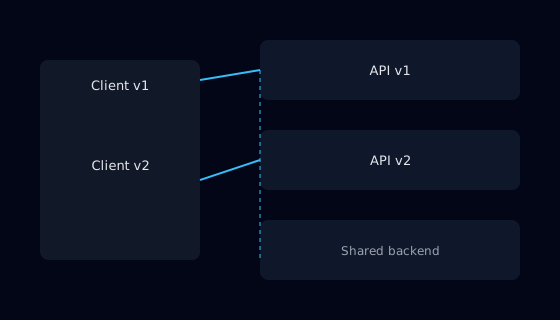
Technically, you need a way to route requests to the correct version of your API implementation. For small differences, a single codebase with conditional handling may be sufficient. For larger differences, you might maintain separate modules or deployments for each major version.
Whatever approach you choose, ensure that behavior for each version is testable in isolation. Automated tests should verify that new changes do not accidentally alter the behavior of older versions. Observability is also important: logs and metrics should allow you to see how much traffic each version receives and how error rates compare.
4.5 Communicate Changes and Provide Migration Guides
Versioning is not only a technical mechanism but also a communication channel. When you introduce a new version, clearly describe what has changed and why. Provide migration guides that show clients how to update their requests and how to interpret new responses.
Use multiple channels, such as release notes, documentation updates, and direct notifications for key integrators. The easier it is for clients to upgrade, the less pressure you will feel to support old versions indefinitely.
5. Common Mistakes and How to Avoid Them
A frequent mistake is introducing a new version for every minor change. This leads to a proliferation of versions that are costly to maintain and confusing for clients. To avoid this, reserve new major versions for breaking changes and treat additive, backward compatible changes as part of the existing version.
Another mistake is failing to remove unused versions. Keeping a large number of historical versions increases operational complexity and can hide the fact that some integrations are effectively abandoned. Use usage metrics to identify versions that receive little or no traffic and schedule their retirement according to your policies.
A third mistake is changing behavior within a version without clear communication. If you must modify behavior in a way that might surprise clients, treat it as a versioned change and follow your normal process, even if it seems small. Consistency builds trust over time.
6. Practical Example or Use Case
Consider an order management API that starts with version 1. After several months, the team discovers that the original representation of order status is too limited. Changing the status field directly would break existing clients. Instead, the team introduces version 2 with an improved representation and continues to serve version 1 for a defined period.
During this period, the team publishes a migration guide that explains how to map old statuses to the new model. Monitoring shows that most traffic gradually moves to version 2. After the agreed deprecation window, version 1 is retired. Because the process is predictable, integrators plan upgrades without surprises.
7. Summary
API versioning is a practical tool for managing change in backend systems. By distinguishing between breaking and non breaking changes, choosing a clear version identifier, and defining lifecycle policies, you provide a stable contract for clients while still allowing the API to evolve.
Technical mechanisms such as routing and testing must be complemented by strong communication and documentation. When clients understand what each version means and how long it will be supported, they can integrate with confidence. Over time, a disciplined versioning strategy reduces accidental breakage and supports sustainable API growth.