Backend Integration Testing for APIs
1. Introduction
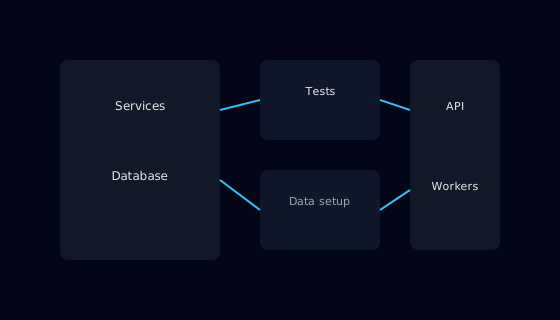
Unit tests are valuable for validating individual components, but they do not guarantee that a backend system behaves correctly when all parts interact. Integration tests fill this gap by exercising real combinations of services, databases, and infrastructure components. For HTTP based APIs, integration tests often provide the most direct evidence that important workflows function as intended.
This guide explains how to design and implement integration tests for backend services in a way that is reliable, maintainable, and suitable for continuous integration pipelines. It focuses on realistic test environments, stable test data, and clear separation between fast feedback tests and broader system checks.
The goal is to gain confidence in critical paths without creating brittle tests that break with minor implementation changes.
2. Who This Guide Is For
This guide is aimed at backend developers, test engineers, and technical leads responsible for the quality of APIs and services. It assumes familiarity with basic testing concepts and some experience running unit tests, but it does not require prior expertise with large scale test environments.
It is also helpful for DevOps and platform engineers who provide shared infrastructure for running tests, as integration testing often relies on containers, ephemeral databases, or dedicated test clusters.
3. Prerequisites
Before implementing integration tests, you should have a way to start your backend service in a controlled environment, such as via a container image or a scripted startup process. You should also be able to provision a test database or use an in memory alternative that is isolated from production data.
A basic unit test suite is recommended so that integration tests can focus on cross component behavior rather than replacing all lower level checks. Finally, you need a test runner or framework capable of making HTTP requests, asserting responses, and managing setup and teardown steps.
4. Step-by-Step Instructions
4.1 Identify Critical Workflows
Begin by listing the most important end to end workflows in your system. For an order management API, these might include creating an order, processing a payment, and updating shipment status. Each workflow should have a clear start point, such as an HTTP request, and a clear expected outcome in terms of responses and data changes.
Prioritize workflows that cross multiple boundaries: services, databases, and external integrations. Integration tests are most valuable where failures would be especially costly or difficult to detect through unit tests alone.
4.2 Design a Test Environment
Next, design an environment where integration tests can run safely and repeatably. This may involve starting your service in a container, connecting it to an isolated database instance, and mocking or simulating external systems such as payment gateways. The key is to control all dependencies so that tests do not depend on shared or unstable resources.
Ensure that tests can set up and tear down data without manual intervention. Common approaches include resetting the database between test runs, using transaction rollbacks, or seeding known datasets at the beginning of the test suite.
4.3 Implement Tests for Each Workflow
For each critical workflow, write tests that perform real HTTP requests against the running service. Validate not only the status codes but also the structure and content of response bodies. When appropriate, verify side effects such as records written to the database or messages published to queues.
Structure tests to be clear and self contained. Use helper functions to create prerequisite entities, such as customers or products, so that the main test logic remains focused on the specific workflow being validated.
4.4 Integrate with Continuous Integration
Once integration tests are reliable locally, add them to your continuous integration pipeline. Decide whether all integration tests should run on every commit or whether a subset should run frequently with a larger set scheduled periodically. The balance depends on test duration and resource constraints.
Monitor test flakiness carefully. Tests that pass or fail unpredictably erode trust in the pipeline. When a test appears flaky, investigate whether the cause is environmental instability, insufficient isolation, or timing assumptions in the test code.
4.5 Maintain and Evolve the Test Suite
As your backend evolves, regularly review integration tests to ensure they remain aligned with current behavior. Avoid letting obsolete tests accumulate; they consume resources and can confuse developers who try to understand system behavior.
When new features are added, consider whether they extend existing workflows or introduce new critical paths. Add or adjust integration tests accordingly. Treat the test suite as a living asset, not a one time project.
5. Common Mistakes and How to Avoid Them
A frequent mistake is trying to cover every detail of the system with integration tests, leading to a slow and fragile test suite. Instead, reserve integration tests for workflows where multiple components interact in ways that cannot be adequately covered by unit tests alone. Allow unit and component tests to carry most of the load for detailed logic.
Another mistake is relying on shared test databases that are manually managed. Over time, such environments accumulate inconsistent data and hidden dependencies, causing tests to pass or fail depending on their execution order. Use automated setup and teardown processes so that each test run starts from a known state.
A third mistake is ignoring test flakiness. Treat intermittent failures as defects to be investigated, not as noise to be tolerated. Flaky tests often indicate real issues such as race conditions, timeouts, or incorrect assumptions about external systems.
6. Practical Example or Use Case
Consider a team building a payments API. Initially, they rely primarily on unit tests and manual testing in a shared staging environment. Occasionally, integration issues with the payment provider or database occur only after deployment, forcing rollbacks and urgent hotfixes.
By introducing integration tests that run against a simulated payment gateway and an isolated test database, the team begins to catch issues earlier. Tests cover workflows such as successful payments, declined cards, and timeout scenarios. These tests run automatically in the CI pipeline on each pull request.
Over time, the number of production incidents related to integration issues decreases, and developers gain more confidence in making changes to payment logic. Integration testing becomes an integral part of the development lifecycle rather than an afterthought.
7. Summary
Backend integration testing bridges the gap between unit tests and full system validation. By focusing on critical workflows, controlled environments, and stable test data, you can build a test suite that provides meaningful assurance without overwhelming your pipeline.
Maintaining integration tests alongside application code and treating flakiness as a problem to solve, not to ignore, ensures that the suite remains trustworthy. When applied thoughtfully, integration testing becomes a powerful tool for improving the reliability of backend APIs and the systems that depend on them.