Designing Practical REST APIs
1. Introduction
RESTful APIs are the public face of many backend systems. They expose data and operations to web applications, mobile apps, other services, and internal tools. A well designed API is predictable, consistent, and stable over time, even when the underlying implementation changes. A poorly designed API, in contrast, quickly becomes a source of bugs, breaking changes, and duplicated work across clients.
This guide focuses on practical decisions you make when designing a REST API. Instead of trying to cover every possible style, it aims to provide a clear baseline that works for typical business applications. The goal is not to create a perfectly pure REST interface, but to deliver an HTTP based API that is easy to consume, easy to extend, and safe to evolve.
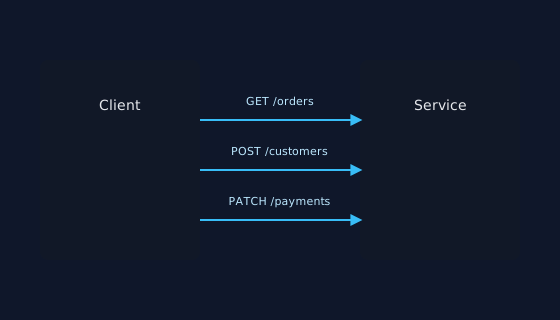
Throughout the guide, the examples focus on HTTP resources such as customers, orders, and payments. The same patterns apply whether your backend is written in a dynamic language, a compiled language, or a mixed stack. The key ideas are resource modeling, stable URIs, clear use of HTTP methods, and predictable response formats.
2. Who This Guide Is For
This guide is written for backend developers, technical leads, and system designers who need to expose functionality over HTTP. It is suitable for people who are building their first serious API as well as those who are refactoring an existing one that has grown organically without a clear structure.
If you already understand basic HTTP verbs and status codes but feel uncertain when deciding how to name resources, how to represent relationships, or how to version your endpoints, this material is designed for you. It does not assume deep experience with network protocols, only a basic familiarity with web development.
The content also helps engineering managers and product owners who need a vocabulary to review API proposals. By understanding the reasoning behind resource design and versioning choices, you can ask better questions and spot designs that are likely to cause problems for clients later.
3. Prerequisites
Before applying the steps in this guide, you should have a clear understanding of the domain you are working in. That includes knowing the core entities, such as customers, products, or tickets, and the key actions users need to perform with them. You do not need a complete specification, but you should know the most important workflows the API has to support.
You should also be comfortable reading and writing basic HTTP requests and responses. For example, you should recognize how a GET request differs from a POST request, and you should be able to read JSON payloads. Tools such as command line HTTP clients or browser based API consoles are sufficient for experimentation.
Finally, you need access to the backend codebase or at least a way to influence it. Many design decisions, such as how to model relationships or how to handle concurrency control, require changes in both the API layer and the underlying services or database.
4. Step-by-Step Instructions
4.1 Identify Core Resources
Start by listing the primary concepts that your clients need to work with. In a simple retail system, these might be customers, orders, products, and payments. Focus on business concepts, not technical details such as cache entries or background jobs. Each important concept is a candidate for a top level resource.
When naming resources, use plural nouns for collections. For example, an endpoint that returns a list
of customer records might be accessible at /customers. A single customer is then
represented at /customers/{id}. This simple convention makes URIs easy to guess and
remember.
4.2 Define Operations Using HTTP Methods
Once you know your resources, decide which operations should be exposed. Map create, read, update,
and delete actions onto HTTP methods. For example, creating a new order corresponds to sending a
POST request to /orders with a JSON body describing the order. Fetching the details of
a specific order corresponds to a GET request to /orders/{id}.
Use PUT or PATCH for updates depending on how you think about the operation. PUT is appropriate when the client sends a complete representation of the resource it wants to store. PATCH is suitable for partial updates where only a subset of fields is modified. DELETE is used to remove resources, either logically or physically, but the semantics should be clearly documented.
4.3 Design Request and Response Bodies
Define a consistent JSON structure for each resource. Choose field names that reflect business
meaning rather than implementation details. For example, use totalAmount instead of a
raw database column name. Keep the top level structure stable even if internal calculations change.
This stability allows clients to upgrade backend versions without breaking.
Always return a structured error body when requests fail. Include a machine readable error code, a human readable message, and optional details such as the field that caused a validation failure. Clients rely on predictable error formats to display useful feedback to users and to implement meaningful retries.
4.4 Handle Filtering, Pagination, and Sorting
For collection endpoints, design query parameters for common operations. Filtering can be implemented
with parameters such as ?status=OPEN or ?customerId=123. Pagination is
often based on either page numbers and sizes or on cursors. Whichever you choose, keep it consistent
across the API so that client libraries can share logic.
Sorting can be exposed using a simple parameter such as ?sort=createdAt,desc. Limit the
number of supported sort fields to those that are meaningful to clients and well indexed in the
database. By controlling these aspects at design time, you avoid the need to expose internal query
details later.
4.5 Choose a Versioning Strategy
Even with careful design, APIs evolve. New fields are added, old behavior is deprecated, and
sometimes breaking changes are unavoidable. Selecting a versioning strategy early helps you manage
this evolution. A common approach is to include the version in the path, for example
/v1/orders and /v2/orders. Another option is to use a header that
specifies the requested version.
Whichever strategy you adopt, document it and apply it consistently. Clients should never have to guess whether a breaking change has been introduced. The presence of a version conveys a contract: behavior within a version is stable, and breaking changes arrive only in a new version.
5. Common Mistakes and How to Avoid Them
One frequent mistake is exposing internal database structures directly. For example, returning every column from a table encourages clients to depend on fields that were never intended to be public. To avoid this, design a public representation for each resource and treat the database schema as an implementation detail that can change independently.
Another common issue is inconsistent naming and behavior across endpoints. If one resource uses singular names and another uses plural names, or if similar endpoints use different status codes for the same outcome, clients become more complex and error prone. Maintain a small set of naming and status code conventions and apply them everywhere.
A third mistake is introducing breaking changes without a migration path. Removing a field, changing a response shape, or altering validation rules can silently break deployed clients. Mitigate this risk by following a deprecation process: mark fields as deprecated in documentation, support both old and new fields for a period of time, and only remove them in a clearly announced new version.
6. Practical Example or Use Case
Consider a simple order management API for a marketplace. Clients need to create orders, list orders
for a customer, and update order status as payments are processed and items are shipped. A practical
design would expose endpoints such as POST /orders, GET /orders/{id}, and
GET /customers/{id}/orders. Each order representation would include fields such as
identifiers, timestamps, current status, and monetary totals.
As the system grows, new requirements arrive, such as supporting discount vouchers or partial shipments. By starting with a stable resource design and clear use of HTTP methods, you can incorporate these changes by adding fields or new related resources, rather than by breaking existing endpoints. For example, you might introduce a separate resource for vouchers and link them to orders using identifiers in the response bodies.
This example demonstrates how a careful initial design prevents instability later. Instead of rebuilding the API when features expand, you can evolve it incrementally and maintain compatibility with existing clients, including mobile applications that cannot be updated immediately.
7. Summary
Designing practical REST APIs is about making a series of deliberate choices. By focusing on clear resource modeling, consistent naming, thoughtful use of HTTP methods, and predictable request and response structures, you provide a stable surface for clients. Supporting pagination, filtering, and sorting in a uniform way further reduces friction for consumers.
Equally important is avoiding common pitfalls such as leaking internal database structures or introducing breaking changes without notice. A considered versioning strategy and a disciplined deprecation process help your API evolve without surprising its users. When these principles are applied together, the result is an interface that supports current requirements while remaining flexible for future growth.