Securing REST APIs in Backend Systems
1. Introduction
REST APIs often handle sensitive data and operations, from personal profiles to financial transactions. Security is therefore not an optional enhancement but a core requirement. A single overlooked detail can expose private information or allow unauthorized actions that are difficult to undo.
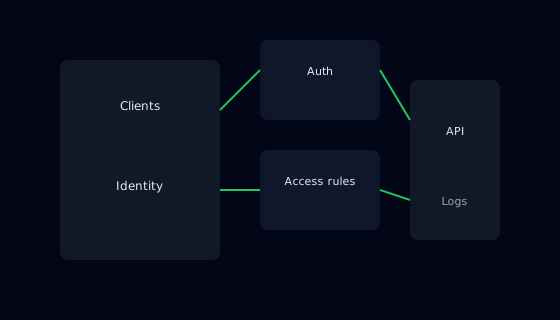
This guide focuses on the practical aspects of securing REST APIs in backend systems. It covers authentication, authorization, transport security, and logging from the perspective of developers who build and maintain services. Rather than prescribing a single technology stack, it describes principles that apply across frameworks and platforms.
By the end of the guide, you should have a checklist of security measures that can be integrated into your development and deployment practices.
2. Who This Guide Is For
This guide is designed for backend developers, security minded engineers, and technical leads responsible for API design and implementation. It is useful whether you are building APIs for internal use, external partners, or public clients such as mobile apps and web frontends.
Security specialists can also use this guide to align with development teams on practical steps and trade offs. Shared terminology and expectations make security reviews more efficient and less adversarial.
3. Prerequisites
Before applying the recommendations here, you should understand basic HTTP concepts, including headers, status codes, and request methods. Familiarity with your authentication mechanisms, such as session cookies, API keys, or token based systems, will help you map the principles to your environment.
You should also have access to configuration for your API gateway or reverse proxy, as many transport level and rate limiting controls are implemented there rather than in application code.
4. Step-by-Step Instructions
4.1 Enforce Transport Security
Start by ensuring that all client communication with your API occurs over HTTPS. Transport Layer Security (TLS) protects data in transit from eavesdropping and tampering. Redirect plain HTTP traffic to HTTPS, and configure strict transport security headers where appropriate.
Use up to date TLS protocols and cipher suites following current best practices. Termination can happen at a gateway or load balancer, but you must treat any point beyond that boundary as potentially untrusted if traffic leaves your controlled network segments.
4.2 Implement Strong Authentication
Choose an authentication mechanism that fits your clients. For browser based applications, modern token based flows layered on top of secure cookies are common. For server to server communication, signed tokens or mutual TLS can provide strong guarantees. Avoid home grown schemes where established standards exist.
Regardless of the mechanism, centralize authentication logic so that all endpoints rely on the same core verification steps. Include protections against common attacks such as replay attempts and credential stuffing, and ensure that authentication failures do not leak sensitive information about account existence or internal errors.
4.3 Apply Authorization Checks Consistently
Authentication answers the question “who is making this request”; authorization answers “are they allowed to do this”. Design a clear authorization model, such as role based access control or permissions derived from resource ownership. Avoid scattering ad hoc checks throughout the codebase.
Implement authorization at the boundary of each protected operation. For example, before returning a resource, confirm that the caller either owns it or has a role that grants access. When updating or deleting data, perform checks based on both the requested action and the specific resource state.
4.4 Validate and Sanitize Inputs
Robust input validation complements authentication and authorization. Validate data types, lengths, and formats for all incoming parameters and payload fields. Reject requests that do not conform to expectations with clear but generic error responses.
Sanitize any data that may be used in dynamic contexts, such as log entries or downstream messages. Even when you use parameterized queries for database access, input validation helps prevent unexpected behavior and reduces opportunities for misuse.
4.5 Log Security Relevant Events
Security controls are only as effective as your ability to observe and respond to incidents. Log key events such as authentication failures, authorization denials, changes to critical settings, and unusually high request rates. Ensure that logs include enough context to trace activity without storing sensitive information such as raw passwords or full tokens.
Centralize logs and monitor them for patterns that may indicate abuse, such as repeated failed attempts from the same IP range or access to unusual combinations of endpoints. Integrate alerts with incident response procedures so that potential issues are investigated promptly.
5. Common Mistakes and How to Avoid Them
A common mistake is relying on obscurity, such as unlinked endpoints or unusual URLs, as a primary security measure. Attackers can discover endpoints through traffic analysis or source code leaks, so controls must not depend on secrecy alone. Always enforce proper authentication and authorization regardless of how “hidden” an endpoint seems.
Another mistake is inconsistent application of security checks. If most endpoints require authentication but a few do not due to oversight, those gaps may allow unintended access paths. Automated tests and security reviews should include checks that all protected resources enforce the expected policies.
A third mistake is exposing overly detailed error messages to clients. While detailed diagnostics are useful for developers, they can provide attackers with information about internal implementations or valid accounts. Design external error messages to be minimal while logging full details securely for internal use.
6. Practical Example or Use Case
Consider a backend API used by both mobile applications and internal tools. Initially, the API accepts requests over both HTTP and HTTPS and uses custom query parameters for authentication. Some endpoints implement authorization checks while others rely on clients to “do the right thing”.
By adopting the practices from this guide, the team moves to mandatory HTTPS, introduces a standardized token based authentication mechanism, and centralizes authorization logic based on roles and resource ownership. They add input validation for all endpoints and configure structured logging for security events.
As a result, the API becomes more resilient to common attacks, and the team gains improved visibility into suspicious patterns. Security reviews become more constructive because discussions revolve around clear principles and implemented controls.
7. Summary
Securing REST APIs requires attention to multiple layers: transport, authentication, authorization, input validation, and logging. Addressing each of these areas systematically reduces the attack surface and makes it easier to reason about the overall security posture of your backend.
By avoiding reliance on obscurity, applying consistent policies, and balancing external error messages with rich internal logging, you create services that are both safer and more manageable. When security concerns are integrated into everyday development practices rather than treated as an afterthought, they support rather than hinder the evolution of your APIs.