Writing Safe SQL Queries in Backend Services
1. Introduction
SQL is a powerful language for working with relational data, but it is also a common source of bugs and security vulnerabilities. Unsafe queries can expose sensitive information, corrupt data, or open the door to injection attacks. For backend services that interact with databases on behalf of many users, careful query design is essential.
This guide focuses on practical techniques for writing safe, maintainable SQL in backend applications. It emphasizes parameterization, clear structure, and predictable behavior rather than relying on clever or opaque SQL constructs. The goal is to make queries easy to review, test, and modify as the system evolves.
Examples assume a typical service that uses a database driver or abstraction layer to execute SQL statements. The principles apply whether your backend is written in Java, Go, Node.js, or another language with SQL support.
2. Who This Guide Is For
This guide is intended for backend developers who write SQL directly or through lightweight abstraction layers. It is especially relevant if you are responsible for both application logic and data access code, and you want to reduce the likelihood of subtle query related defects.
Technical leads and code reviewers can also use this guide as a reference when evaluating patches that touch database access logic. Having a shared standard for safe queries reduces disagreements and encourages consistent practices.
3. Prerequisites
Before applying the recommendations in this guide, you should understand basic SELECT, INSERT, UPDATE, and DELETE statements and be comfortable reading query plans at a high level. Familiarity with your application’s database driver or ORM will help you translate the concepts into concrete code.
You should also have access to a development or test database where you can experiment with queries without affecting production data. Being able to run queries and observe their effects is essential for building confidence in your data access patterns.
4. Step-by-Step Instructions
4.1 Always Use Parameterized Queries
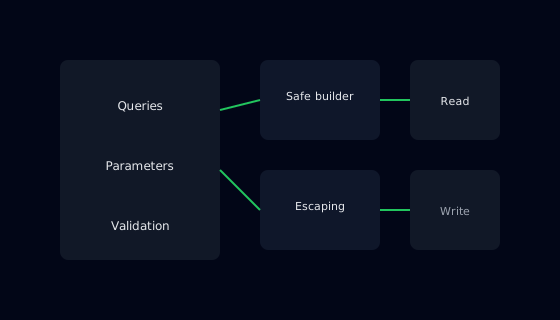
The most important rule for safe SQL is to use parameterized queries instead of string concatenation. Parameterization means that the SQL statement and its data values are sent to the database separately, preventing user input from being interpreted as executable code. Almost all modern database APIs provide this capability.
In practice, this means writing queries with placeholders for values and passing the actual values as parameters from your backend code. Avoid building WHERE clauses by manually inserting strings; instead, construct the query structure in code and let the driver bind values safely.
4.2 Keep Queries Focused and Readable
Complex queries are sometimes necessary, but many issues arise from statements that perform too many responsibilities at once. Whenever possible, design queries that solve a single, clear problem. For example, separate the retrieval of a list of orders from the calculation of aggregated statistics unless combining them provides a concrete performance benefit.
Use indentation and consistent formatting for multi line queries in your codebase. Group conditions logically, and give explicit names to intermediate results using common table expressions when supported. Readable queries are easier to test and less likely to contain hidden logic errors.
4.3 Validate and Constrain Inputs Before Query Execution
Even with parameterized queries, you should validate inputs in your application before passing them to the database. Ensure that numeric parameters fall within expected ranges and that enumerated values such as statuses match known constants. This prevents unnecessary database errors and makes behavior more predictable.
For dynamic filtering, define a limited set of allowed fields and operations rather than allowing arbitrary column names or operators. For example, when implementing sorting, map client supplied sort keys to a predefined list of columns, and reject unsupported values. This approach eliminates whole classes of injection risks and accidental misuse.
4.4 Handle Transactions Explicitly
When multiple queries must succeed or fail together, use transactions deliberately. Begin a transaction, execute the required statements, and either commit if all succeed or roll back if any fail. Avoid implicit transaction behavior that depends on driver defaults, as it may differ between environments or change with configuration.
Keep transactions as short as possible. Holding locks for longer than necessary can reduce concurrency and lead to deadlocks. Design application level workflows so that checks and user interactions occur outside of transactions, leaving only the minimal set of database operations inside.
4.5 Monitor and Optimize Problematic Queries
Safe queries can still be slow if they are not designed with performance in mind. Use database tools to identify queries with high latency or frequent timeouts. Examine execution plans and indexes to understand why a query is expensive. Often, adding or adjusting an index or rewriting a predicate can significantly improve performance without changing semantics.
When optimizing, make small, incremental changes and measure their effects. Avoid rewriting queries wholesale unless necessary; large changes are harder to validate and may introduce new risks. Document the reasoning behind significant optimizations so that future maintainers understand their purpose.
5. Common Mistakes and How to Avoid Them
A classic mistake is constructing SQL statements by concatenating strings that contain user input, such as search terms or identifiers. This pattern is vulnerable to injection attacks and can also produce syntactically invalid queries if values contain unexpected characters. The remedy is to adopt parameterized queries consistently and to review code for unsafe string concatenations.
Another mistake is silently ignoring database errors or mapping all failures to a generic message. While clients should not see internal details, developers need access to precise error information. Log detailed error codes and messages in a secure location, and design error responses that differentiate between client mistakes, such as invalid input, and server side issues.
A third mistake is embedding complex business logic directly in SQL using deeply nested subqueries or vendor specific functions. While some logic belongs close to the data, excessive complexity makes queries hard to port and maintain. Consider moving intricate rules into application code where they can be covered by unit tests and refactored more easily.
6. Practical Example or Use Case
Imagine a backend service that provides an endpoint for searching orders by customer name and date range. An initial implementation might construct a SQL statement by interpolating user supplied values directly into a WHERE clause. During testing, the team discovers that certain inputs cause syntax errors and, more importantly, that maliciously crafted inputs can alter the intended query.
By refactoring to use parameterized queries, validating date ranges, and limiting sort options to a predefined list, the team eliminates these vulnerabilities. They also introduce a consistent error handling strategy that logs detailed database errors while returning clear but generic messages to clients. Over time, the search endpoint becomes both safer and easier to extend with new filters.
7. Summary
Writing safe SQL queries is a core responsibility for backend developers who work with relational databases. Parameterization, input validation, clear structure, and explicit transaction management are practical tools for reducing risk and improving reliability.
By avoiding dangerous patterns such as string concatenation with untrusted input and overly complex inline logic, you create queries that are easier to review and maintain. Combined with monitoring and targeted optimization, these practices help ensure that your data access layer remains both secure and performant as your system grows.